
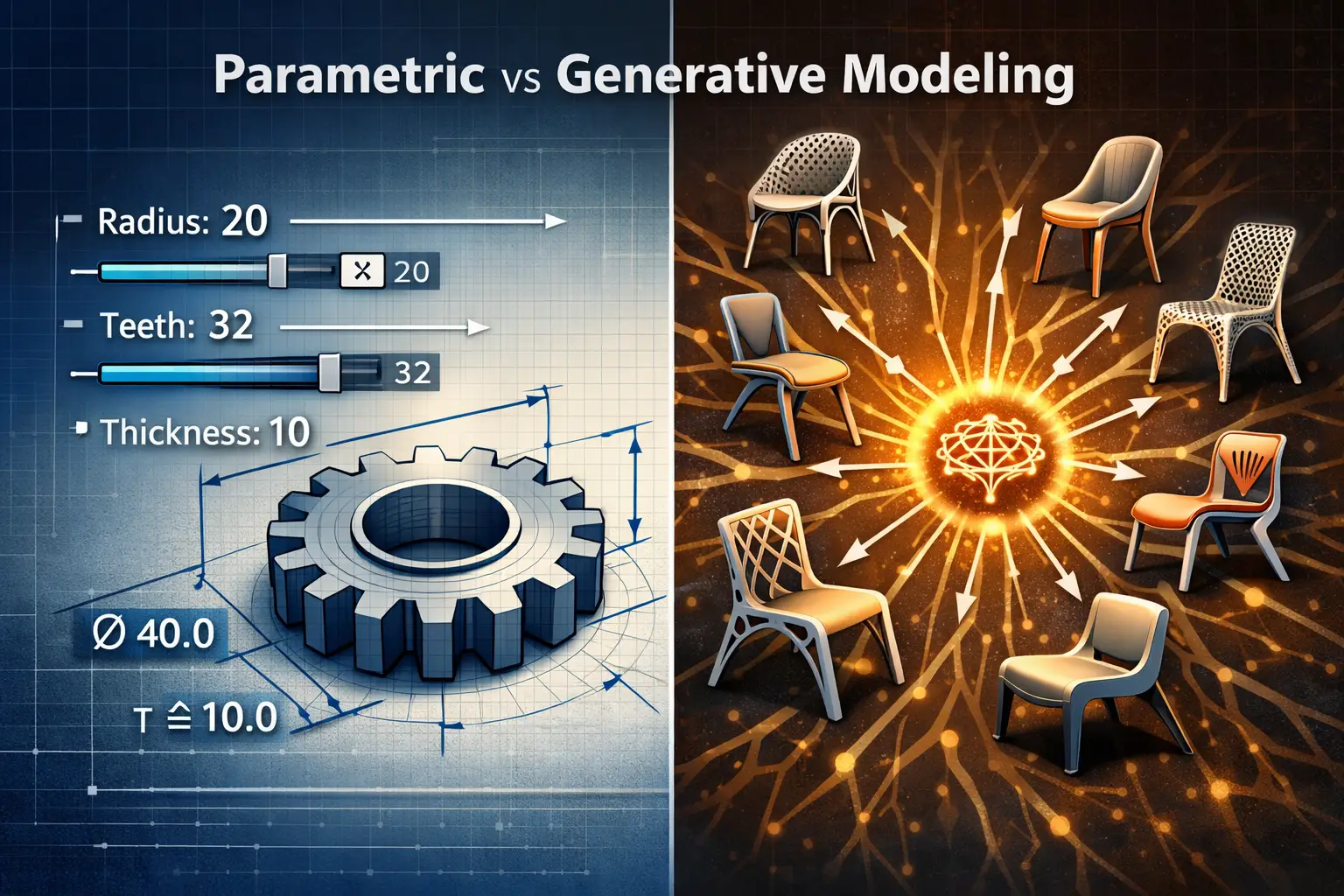
 Parametric Modeling
- Approach: Dimension and constraint-driven
- Strengths: Precision, predictability, easy change management
- Best for:
- Injection-molded parts
- Mechanical assemblies
- Sheet metal components
- Manufacturing drawings & BOMs
- Software: SolidWorks, CATIA, Siemens NX, Creo, Fusion 360 (parametric mode)
- Why it dominates: Supports GD&T, tolerances, revision control, and standardized documentation.
 Generative Modeling
- Approach: Goal-driven, algorithmic optimization
- Strengths: Innovation, lightweighting, performance optimization
- Best for:
- Aerospace lightweight structures
- Automotive strength-to-weight parts
- Topology-optimized brackets
- Additive manufacturing / 3D printing
- Software: Fusion 360 Generative Design, Siemens NX, Rhino Grasshopper
- Why it shines: Creates organic, optimized shapes beyond human intuition.
 Key Differences
| Aspect | Parametric Modeling | Generative Modeling |
|---|---|---|
| Design Approach | Rule-based | Goal & optimization |
| Control | Total geometric control | Software explores possibilities |
| Output | Predictable, defined | Multiple optimized variations |
| Suitability | Mechanical, industrial | Innovation, lightweighting |
| Change Handling | Easy updates via constraints | Requires new goals/parameters |
 Practical Example
- Bracket with fixed hole distance & tolerances → Parametric
- Bracket 30% lighter but equally strong → Generative
 When to Use Each
- Parametric: Accuracy, manufacturability, documentation, revision control.
- Generative: Creativity, performance optimization, lightweighting, additive manufacturing.
- Hybrid: Use generative for concept exploration, parametric for final manufacturable design.
 Industry Note
Many companies still prefer parametric modeling for production workflows. However, generative modeling is increasingly valuable in aerospace, automotive EVs, and advanced manufacturing.
 Outsourcing tip: Firms like ThinkCAD Technologies specialize in structured parametric CAD workflows, ensuring manufacturable, revision-friendly outputs.
